Retirement in the Age of AI

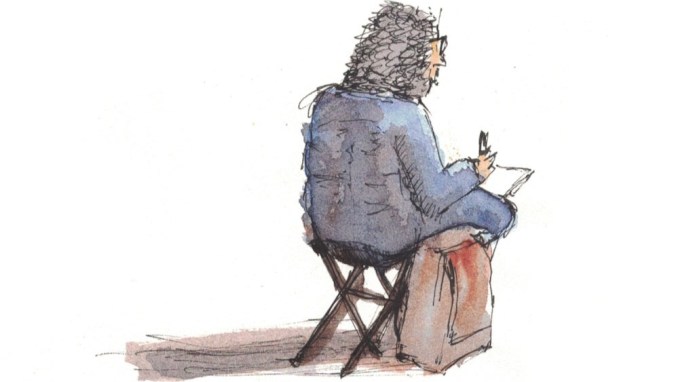
A retired woman sitting on a portable stool, sketching in her notebook. She sits with her back to us, giving a glimpse over her shoulder of what she might be drawing.

While kicking back at my computer with a cup of hot coffee, I shut my eyes and tried to imagine the future I’ll retire into. What would the world resemble once AI replaces a majority of mid-level business and administrative positions? So I opened my eyes and asked AI: What will life be like in the year 2030, especially the United States, after the impending AI Revolution?

AI’s response, in part:

🌍 The Year 2030: When Work Changes Forever

In 2030, the global economy no longer revolves around labor—it revolves around orchestration. AI systems now perform most mid-level corporate tasks: logistics, accounting, diagnostics, even legal drafting. The only required corporate employees are those who manage the AI infrastructure staff.

This shift leaves millions of Americans, especially Gen Xers through Gen Z, without traditional employment opportunities. However, rather than collapse, society pivots. New local economies emerge, providing new opportunities for communal connection.

💸 Universal Basic Income: The New Floor

Each year, the US Treasury issues all adult US citizens a $50,000 stipend, paid for by taxes on downsizing organizations. The basic stipend is enough to cover housing, food, and utilities. While not lavish, it’s stable. Some people, to keep busy, start up their own small businesses or fill low-level service jobs — bartending, caregiving, delivery — not necessarily out of need, but to enjoy work’s daily structure, its social engagement, and the supplemental income it provides.

A quiet economic revolution has occurred, one as disruptive as the car economy replacing the horse economy. In the early 1900s, blacksmiths, stable hands, and leather workers, all lost their livelihoods when city streets stinking of manure gave way to city air stinking of gasoline exhaust. Back then, new industries emerged. The same is starting today.

🎨 Hobbies, Hustles, and Human Flourishing

Freed from the daily grind of holding down an office job, many people turn inward to explore their latent talents. Painters paint. Coders build indie games. Gardeners grow food for their neighbors. Some monetize their passions; others simply live more slowly, adapting to a pace that allows for reflection and expression.

After the initial shock and fear of the unknown, displaced workers soon came to appreciate how the economy has bifurcated, how AI handles the infrastructure while humans handle the soul. With more time available to mingle and socialize, neighborhoods create more neighbors and fewer passing strangers.

🏥 Healthcare: Basic for All, Premium for Some

To help lower life expenses, the federal government provides universal healthcare that covers preventive care, emergencies, and chronic conditions. Private insurance still plays a role—especially for elective procedures, advanced therapies, or boutique services. It’s a two-tiered system, one that funds innovation, one that provides general benefits for all.

👶 Population Pressure and Ethical Dilemmas

With fewer people working, providing more time for leisure and social interaction, AI has determined that human destiny is best served with slower population growth. To prevent a potentially catastrophic baby boom, abortion is available though without federal funding. Federal funding is available, however, for younger adults looking to self-sterilize.

While controversial, the self-sterilization debate has been framed as a choice—an opt-in benefit for those desiring a life without generational legacies.

What Do You Think?

Have you considered the near-future changes to society and how it might affect your retirement choices? I just hope that, along with my pension, I also get a universal income stipend.
Retirement Option #2: Guanajuato, Mexico

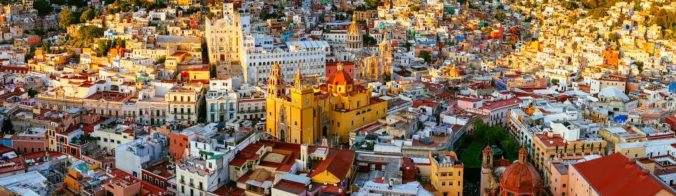
Panoramic photograph of Guanajuato, Mexico.

Though spending only a weekend there more than forty years ago, I still carry found memories of Guanajuato – its rain-glistened cobblestone streets full of mariachi music, its little plazas and sidewalk cafes surrounded by brilliant bold colors.

For decades, I’ve dreamed of returning.  To start, I hope to stay for a month or two and take Spanish lessons at a local school, meeting other expats and local artists and academics – all while drawing and painting in my portable watercolor sketchbook.

After that, I’d like to branch out, spending time in each of the surrounding mountain pueblos, all of them rich with revolutionary history, with the lingering echoes of miners’ cries as they discovered silver and gold.  I’ll sketch the Tao all over these towns and, perhaps, find one for settling down.

San Felipe

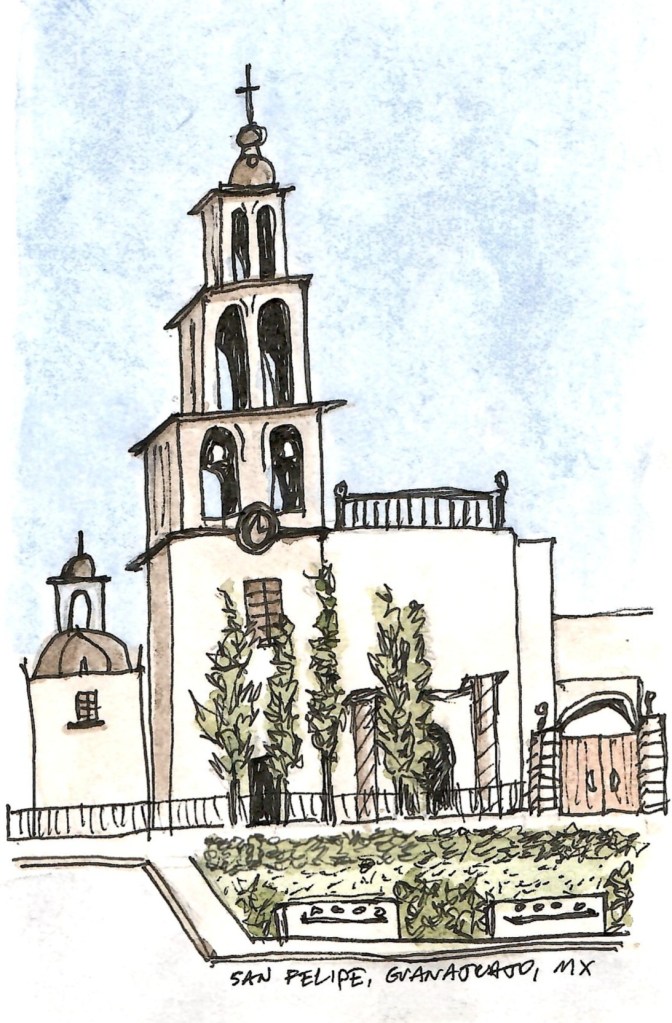
A pen-and-ink watercolor illustration of the main church in main plaza of San Felipe, Guanajuato, Mexico.

Long before the Spanish arrived in the mid-16th century, the Chichimeca people populated this region that borders the stunning Parque Nacional Sierra de Lobos, which served as a natural forested fortress for their defense. 

Their legacy adds a layer of ancestral depth to the pueblo’s identity — one of rooted resilience, one that moved Mexico to seek independence from Spain.

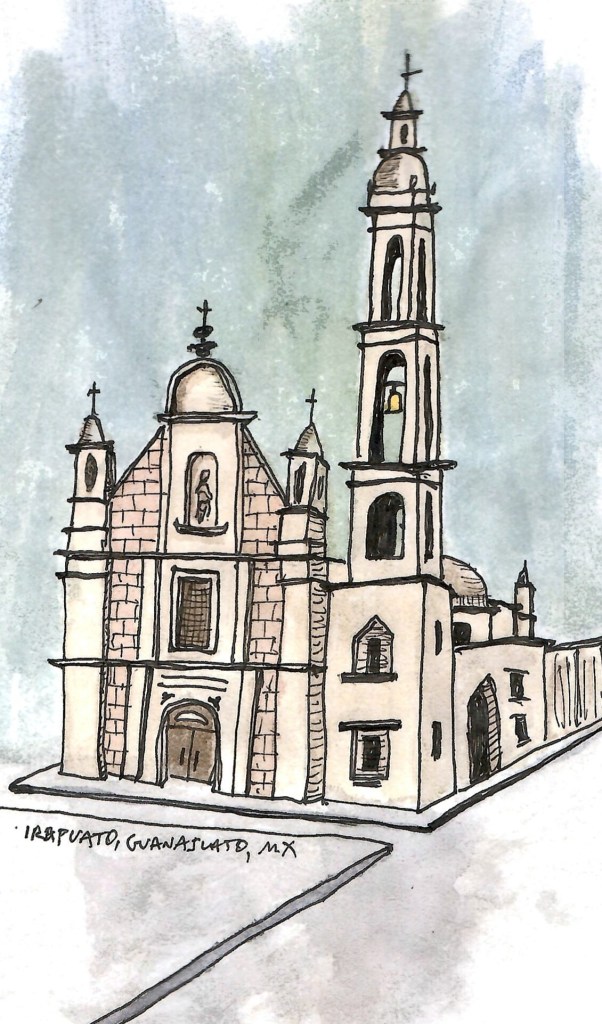
Irapuato

With its famed fertile soil and temperate climate, Irapuato was originally known for its yield of sweet guavas. Today, it harvests the majority of Mexico’s juicy strawberry crop and celebrates its annual yield with a Festival de la Fresas

Stretching over six kilometers, its ornate 18th-century Romanesque aqueduct channels nearby mountain water to the colonial city’s center, where it nourishes a lavish botanical garden.

A pen-and-ink watercolor illustration of the main church in main plaza of Irapuato, Mexico.

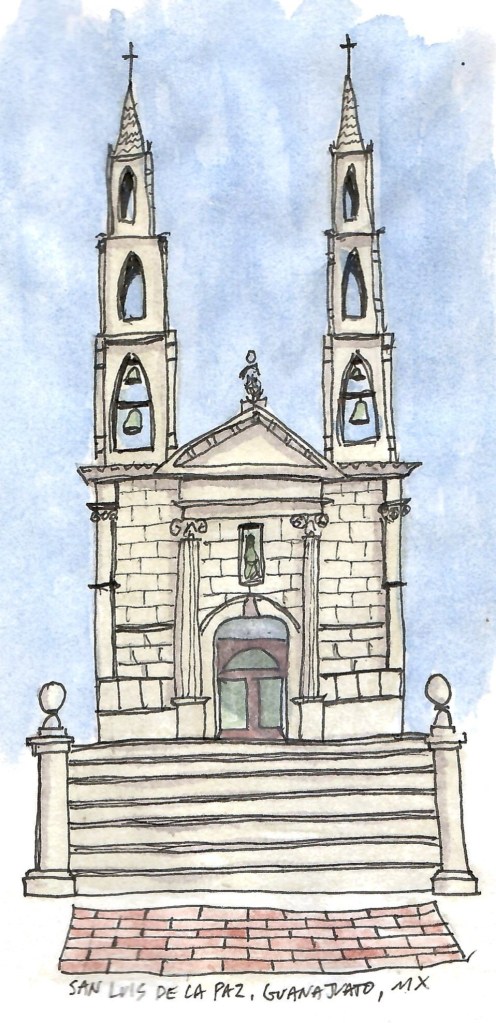
San Luis de la Paz

A pen-and-ink watercolor illustration of the main church in main plaza of San Luis de la Paz, Mexico.

Founded in August 1552 to mark the Spanish-brokered peace treaty between the native Otomi and Chichimeca peoples, San Luis de la Paz stands today as a symbol of resistance, resilience and reconciliation.

Once a strategic outpost along the Spanish Silver Route, the town — surrounded by sacred mountains, winding rivers, and striking rock formations — played a vital role in colonial trade and cultural exchange across the central Mexican highlands.

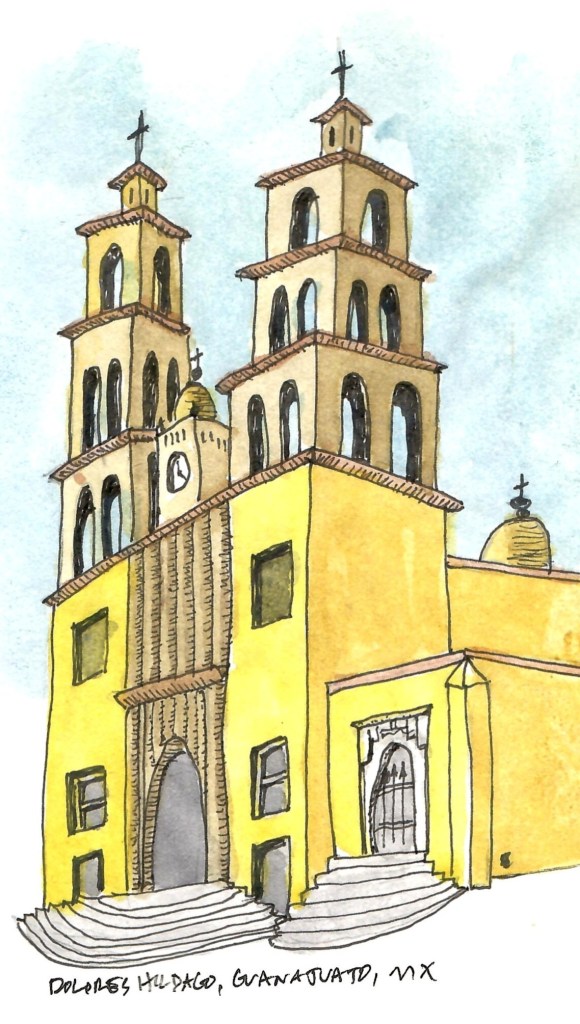
Dolores Hidalgo

In 1810, Father Miguel Hidalgo sounded the church bells, el Grito de Dolores, igniting a revolution. Today, Dolores Hidalgo’s central plaza teems with pottery workshops, mariachi echoes, and the warmth of colonial charm.

Designated a Pueblo Mágico, the town invites visitors to savor strawberry ices, to honor José Alfredo Jiménez’s poetic legacy, and to sample the quiet rise of vineyards amid its storied, sunlit hills.

A pen-and-ink watercolor illustration of the main church in main plaza of Dolores Hidalgo, Mexico.

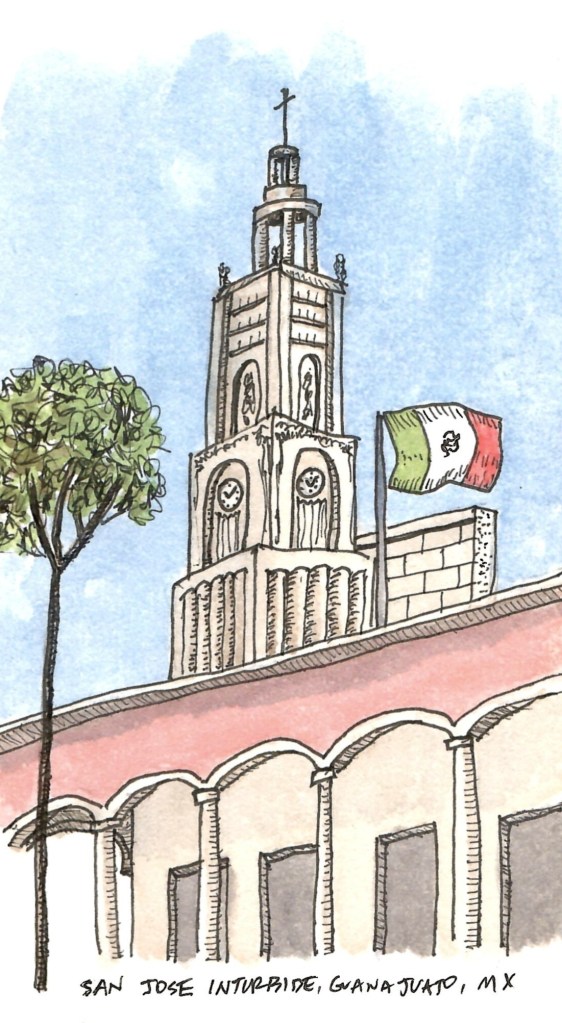
San Jose Iturbide

Pen-and-ink watercolor sketch of a church tower in San Jose Inturbide. A Mexican flag flies from a nearby pole.

Founded in 1754 as Casas Viejas, the renamed mountain pueblo honors both St Joseph and Agustin de Iturbide, Mexico’s first emperor, with stunning neoclassical and Baroque architecture; festive spring traditions; and culinary delights such as cajeta, a goat’s-milk caramel.

In dusty whispers of one-time wealth, local lore speaks of mining carriages rumbling down cobbled colonial roads, of wooden wheels on chiseled stone as they ferried silver, cinnabar, and dreams of fortune from Sierra Gorda mines.

How About You?

Ever been to Guanajuato or any of its surrounding pueblos? Tell me about it in the comments.

The Tao of Fasting

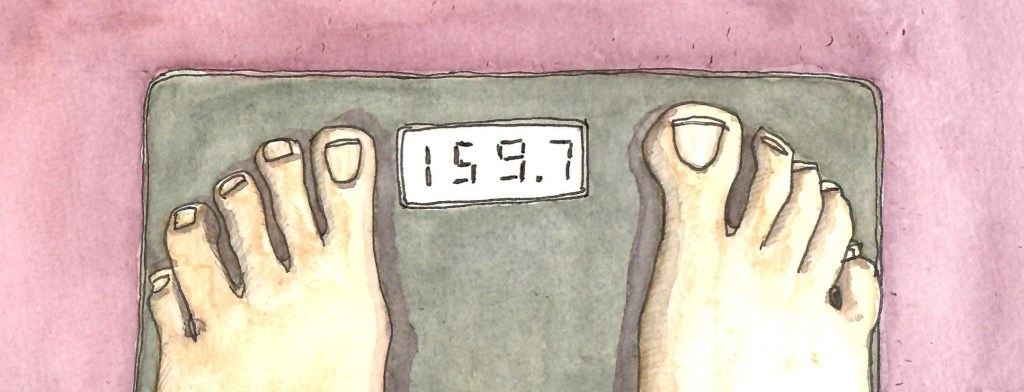
Watercolor image of Papa Gringo's on a bathroom scale, showing the weight as 159.7 pounds.

There’s an old Taoist saying: “To learn the Tao, one must first fast.” Even without understanding the modern scientific benefits of prolonged fasting, such as ketosis and autophagy, and how those benefits heal the body, ancient Taoists understood the spiritual significance of not chowing down on three full squares a day.

Of Ice and Men

Ten thousand years ago, prior to the Ice Age thaw, Stone-Age hunter-gatherers went days without any substantial nutrition, without satisfying the body’s hunger for proteins and fats. Over many millions of years, however, hominid bodies had developed processes to accommodate such long droughts in dining.

Several millennia after the glacial ice caps receded, northern-Chinese Taoists intentionally skipped a few hearty meals in order to stimulate ketosis and kick-start autophagy, allowing the body to initiate its own self-regeneration, to feed off dead and abnormal cells, strengthening the sinews that remained.

Of course, such practice was packaged as preparation for sacred religious rites, preparation that repaired and revived a body not focused on digestion. During fasting periods, senses are heightened, mindfulness improves — two states needed for success when out on extended hunting expeditions.

Full of Emptiness

In Taoism, “emptiness” is not a void to be pitied but a hollow to be hailed — a space where the Tao can flow unimpeded. It is the hollow of bamboo, the pause between breaths, the momentary silence that gives music its melody. Emptiness invites receptivity, humility and, in a spiritual sense, transformation.

Fasting, in this context, becomes the ritual enactment of emptiness: a deliberate clearing of the body’s cravings and the mind’s clutter. By abstaining from food, pungent flavors, and sensory excess, the practitioner cultivates inner quietude, a waking sleep that invites spiritual cognition.

In Taoist ritual, fasting precedes communion with the divine, echoing the belief that only through emptiness can one be filled with the Tao’s subtle presence. It is a practice of becoming porous, open to the mystery of life.

Wu Wei in Action

In Taoism, wu wei — often translated as “non-action” or “effortless action” — is the art of flowing with the natural order rather than forcing outcomes. It’s not passivity; rather, it’s a deep attunement to the rhythms of life, where action arises spontaneously from harmony.

Fasting, when viewed through this lens, becomes a practice of wu wei: a gentle release of control over the body’s desires, allowing the spirit to settle into stillness. Rather than striving or resisting, the practitioner simply surrenders and lets go — of food, stimulation and excess –and, in doing so, returns to a more elemental state.

This emptiness invites clarity, receptivity and alignment with the Tao. Like river water carving mountain stone, not by force but by flowing persistence, fasting in Taoism is a quiet surrender that opens space for surprising discovery. It is a way of becoming light, porous, and attuned to the subtle currents of being.

How About You?

Have you had any past experience with fasting? I lost about five pounds by skipping approximately ten meals last week and simplifying all the meals I did eat. Please share your experience in the comments.

Effects of Saturn in Retrograde

A rams head, the planet Saturn, and a floating gold fish.

Feeling Frustrated? 

If your recent bright ideas have seemed to suddenly dim, if your energy feels jammed or your mojo jacked — you are not alone!  The planet Saturn, now in retrograde, has been throwing cosmic curveballs, striking out our swings at success, sending us back to the bench in the dugout. 

Last spring, on May 25, Saturn entered the sign of Aries, which is normally a time when passionate actions yield promising results.  With Saturn in Aries, we often initiate ambitious projects, accept leadership roles, and embrace a pioneer spirit. 

Back in June, plump summer dreams were ripe on the vine.

But then, on July 13, Saturn turned retrograde, and all our dreams seemed suddenly dashed.  

So What Does Retrograde Mean?  

Physically, as we stand on the Earth with a telescope and track the orbital path of Saturn, a night arrives when the planet appears to reverse direction.  This apparent retrograde occurs when the planet begins to orbit the back side of the Sun while the Earth continues to orbit in front. 

Metaphysically, when a planet goes retrograde, all its positive characteristics are negatively influenced.  What’s strong is weakened.  What’s possible is paused. 

The planet Saturn is the CEO of astrology, the quarterback of our natal charts.  When entering Aires, Saturn adopts the energy of the ram – headstrong, impetuous, confident, determined.   

However, when retrograde, Saturn in Aries begins to second-guess itself.  Confidence wanes.  Caution delays success.  Ever since mid-July, our dreams from early June have seemed hopelessly stalled, no matter our attempts to advance them.   

Luckily, Bad Spells Don’t Last Long

Today, September 1, Saturn leaves the sign of Aires and slips into the introspective waters of Pisces.  Normally, this would feel like stepping into a luxury bubble bath.  Our Saturn CEO would sip champagne and dream of future possibilities. 

But Saturn will still be retrograde, so Pisces negativity will drown our CEO in emotional uncertainty.  We are likely now to abandon our recent ambitious plans, then agonize with guilt for having given up so soon.

Fortunately, on November 28, Saturn ends its retrograde, turns direct again, and resumes its orbit on the same side of the Sun as the Earth.  At that point, we’ll begin to enjoy the positive Pisces traits.  We’ll begin to re-imagine our abandoned plans from spring.  We’ll begin to re-build our emotional core.

A Bright Future in 2026

Early next year, on February 13, Saturn, still going direct, will re-enter the sign of Aries.  Our CEO will once again step up to take charge, to direct immediate action, to lead the campaign toward success.

For me, personally, back at the end of May, I addressed a long-lingering health concern. Complications arose in mid-July, and now I’m due for a Pisces pity party. 

Eventually, though, based on the stars, things will turn around come November.  Come February, I’ll be fully back in shape and ready to conclude the last couple years of my career.  After that, I’ll likely retire in the Spring of 2028, right as Saturn enters the sign of Taurus.  

How About You?

Has Saturn in retrograde effected your recent plans and actions?  Let me know in the comments.