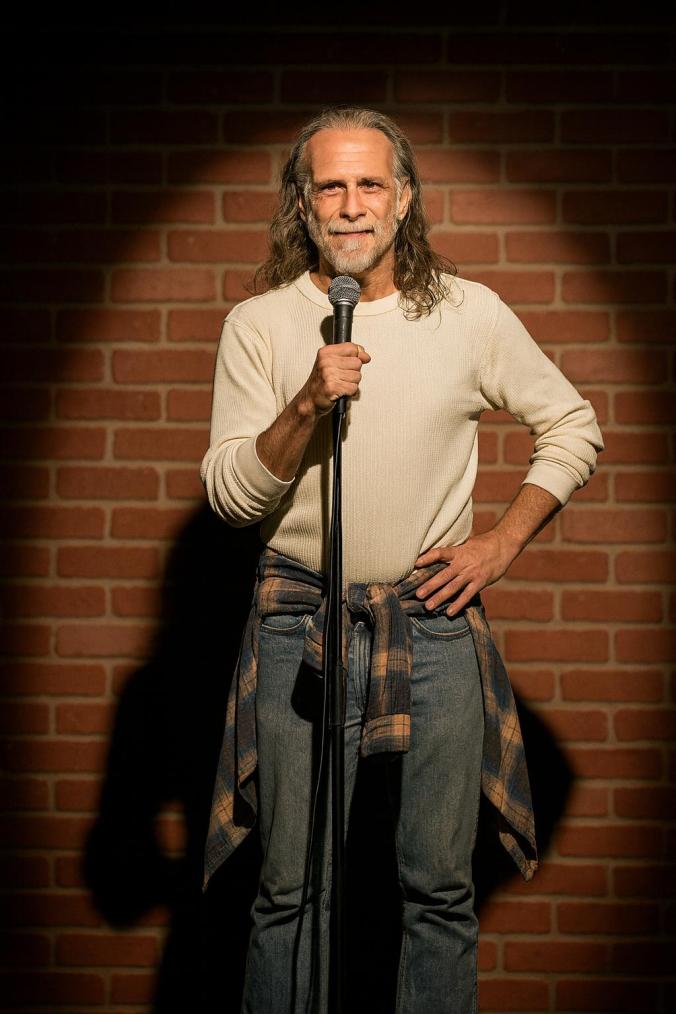
I heard about a Thursday-night comedy open mic at a bar on Dolores Street not far from my house. I walked down earlier this evening to check it out.
I arrived just as the show was about to begin, There were only a few folks sitting at the bar, plus a few others shooting pool in a nook toward the rear. Everyone had their backs to the small stage and microphone stand.
By the front door, a half dozen nervous comics were sitting around as if waiting for the results of a blood test.
Brady, the evening’s MC, took the mic off the stand and said hello to everyone. No one turned to look at him, just the nervous comics.
When the first guy got up, despite no one paying attention, he launched into his set, but it was hard to hear. I tried to keep my focus on him, and I laughed when he presented each premise, but I couldn’t quite catch his punch lines. The next comic was equally hard to hear.
Finally, this one comic got up, one with questionable pronouns. They did great! I could hear them perfectly. Clearly, they’d had some prior public-speaking training. Though they were reading off notes on their phone — something I’ve been told to avoid — I really did enjoy their energy.
Then the MC called my name.
All day, I’d been rehearsing this bit I’d written about the Ohlone Indians. Soon as I got up to the mic, I knew that no one would listen. So I decided to simply practice reciting my memorized lines at the microphone. I did get one laugh from one of the other comics. Mosly, I got nothing. Two-and-half minutes passed like two-and-a-half hours.
All in all, I’d say it was a bomb — the whole show! But bombing can be a blessing.
Everyone busts their cherry some time, and now I’ve busted mine. It was good to get a chance to practice speaking while holding the mic. Good to get a chance to keep addressing different parts of the room. Good to lose my place at one point and then recover from an awkward pause. No one was listening, so none of it mattered.
After the last comic performed, the MC thanked the patrons in the bar — none of whom seemed remotely aware that comics had been performing.
How surreal!
Still, afterward, I got to know a few of the comics, most of whom were heading out to another open mic at another club. They invited me along, but I was wrecked after busting my cherry, so I walked back home while they caught the bus up to Market Street.
Even though the event was a bomb, I’m grateful to have gotten a chance to practice — and to meet some other comics and exchange our contact info. I look forward to seeing them again and joining them on the open-mic circuit all over San Francisco.
How About You?
When was the last time you tried something new, only to discover it may be more challenging that you thought? Let me know in the comments.
Last summer, the Tao kicked my butt, reminding me that retirement’s coming soon, that I should start thinking about life post-teaching. One idea was to start this blog. I liked that idea. I still like that idea.
But now I’m getting kicked in the butt again.
Earlier this month, while replacing a burnt-out bulb in the kitchen, something sparked in my mind. I suddenly thought of pursuing stand-up comedy.
Thirty-five years ago, back in L.A., I had taken some stand-up comedy classes. I did a few open mics. I had a couple good shows. But I never took it beyond that.
I didn’t like the late-night hours or the waiting around for my two-minute turn. Instead, I went to grad school, got myself a masters, moved to the Bay, then started a career teaching college writing.
The teaching path has served me well. I’ve been blessed to have served as a Bodhisattva for so very many students. Standing at the front of all those classes even allowed me the chance to dabble around with standup skills.
However, even today, the thought of attending late-night open mics, of waiting around for a sixty-second spotlight, just doesn’t sound appealing. Still, I’d like to start a regular joke-writing practice. I recently got a couple books and found some writing tips online.
Writing jokes could be fun. Like solving crossword puzzles, it can keep my mushy mind sharp. And I can start an Instagram page and a YouTube channel, both featuring brief video clips of me reciting one-liners or extended little bits.
Writing bits and putting them online is something I could do from anywhere — not only here in San Francisco, but also down south by the Rio de la Plata or up in the hills of Guanajuato.
To be honest, the thought makes me feel a little nervous. I’m afraid I won’t have the talent to write or create consistent funny material. I’m afraid my videos will suck. But even if they do, so what?
It’s fun to try and go with the flow, especially when the Tao is running like a wild summer stream.
What About You?
Have you got any crazy dreams you might be afraid to pursue? Let me know in the comments. I could use a little empathy.
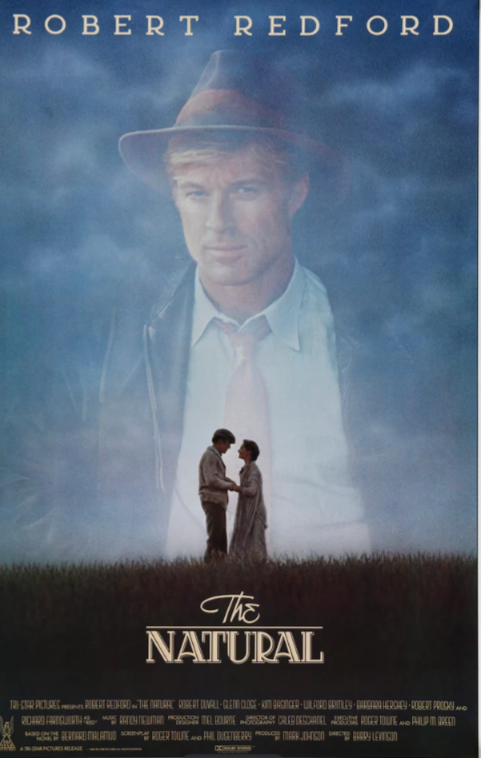
The recent passing of screen-legend Robert Redford got me thinking of his understated performance as Roy Hobbs in the 1984 film The Natural.
Redford as Hobbs, a mysterious baseball prodigy, embodies the Taoist practice of wu wei — the art of unforced action. Hobbs’s natural talents flow effortlessly; and when he plays ball, he flows in harmony with the rhythms of the universe. He doesn’t chase fame or fortune; he simply plays the game he loves.
Taoism teaches that, when one aligns with the Tao, life unfolds with ease. Hobbs’s journey to the major league, though interrupted by tragedy, resumes with quiet determination, not dogged ambition.
Nature as Natural Teacher
The film’s visual language, photographed by Caleb Deschanel with Barry Levinson’s direction, is steeped in nature — golden fields, twilight skies, earth-toned fashions, plus the crack of a bat in the open air.
Taoism reveres nature and its pastoral simplicity. Hobbs, a rookie to big-city corruption, finds ultimate solace and peaceful healing far from the stadium roars, farther still in the quiet countryside with his childhood love and their future dream.
Taoism urges us to live in accordance with nature, and Hobbs’s redemption is only possible when he reconnects with the natural flow.
Characters of Yin & Yang
The film’s characters are rich with duality: good and bad, youth and age, shadows and light. Hobbs’s off-field opponents — gamblers, a manipulative team owner, a blonde femme fatale — represent imbalance and greed. Iris, in contrast, Hobbs’s childhood love, symbolizes light, balance and truth.
Taoism teaches that life is a dance between opposites, that harmony arises when these forces balance out. Hobbs’s own internal struggles — tragedy and redemption, humility and ambition — mirror this Taoist tension. His final triumph is more than athletic; it’s spiritual. Hobbs opts for integrity over fame, restoring balance to his life and the game he loves.
Transcendence & the Tao
The film’s climactic moment, Hobbs’s game-winning homer, means more than victory: It represents transcendence. The ball shatters the stadium lights, raining sparks like stars, a visual metaphor for enlightenment.
In Taoism, the Tao is the eternal Way that underlies all existence. Hobbs’s final swing is a moment of pure alignment with the Tao — no thought, no effort, just being; his eyes on the ball as it cracks off his bat and sails into the sky.
What Do You Think?
Have you ever seen The Natural? What were your thoughts on Redford’s performance? Redford himself, always aligned with nature, surely followed the Tao to success.
There’s an old Taoist saying: “To learn the Tao, one must first fast.” Even without understanding the modern scientific benefits of prolonged fasting, such as ketosis and autophagy, and how those benefits heal the body, ancient Taoists understood the spiritual significance of not chowing down on three full squares a day.
Of Ice and Men
Ten thousand years ago, prior to the Ice Age thaw, Stone-Age hunter-gatherers went days without any substantial nutrition, without satisfying the body’s hunger for proteins and fats. Over many millions of years, however, hominid bodies had developed processes to accommodate such long droughts in dining.
Several millennia after the glacial ice caps receded, northern-Chinese Taoists intentionally skipped a few hearty meals in order to stimulate ketosis and kick-start autophagy, allowing the body to initiate its own self-regeneration, to feed off dead and abnormal cells, strengthening the sinews that remained.
Of course, such practice was packaged as preparation for sacred religious rites, preparation that repaired and revived a body not focused on digestion. During fasting periods, senses are heightened, mindfulness improves — two states needed for success when out on extended hunting expeditions.
Full of Emptiness
In Taoism, “emptiness” is not a void to be pitied but a hollow to be hailed — a space where the Tao can flow unimpeded. It is the hollow of bamboo, the pause between breaths, the momentary silence that gives music its melody. Emptiness invites receptivity, humility and, in a spiritual sense, transformation.
Fasting, in this context, becomes the ritual enactment of emptiness: a deliberate clearing of the body’s cravings and the mind’s clutter. By abstaining from food, pungent flavors, and sensory excess, the practitioner cultivates inner quietude, a waking sleep that invites spiritual cognition.
In Taoist ritual, fasting precedes communion with the divine, echoing the belief that only through emptiness can one be filled with the Tao’s subtle presence. It is a practice of becoming porous, open to the mystery of life.
Wu Wei in Action
In Taoism, wu wei — often translated as “non-action” or “effortless action” — is the art of flowing with the natural order rather than forcing outcomes. It’s not passivity; rather, it’s a deep attunement to the rhythms of life, where action arises spontaneously from harmony.
Fasting, when viewed through this lens, becomes a practice of wu wei: a gentle release of control over the body’s desires, allowing the spirit to settle into stillness. Rather than striving or resisting, the practitioner simply surrenders and lets go — of food, stimulation and excess –and, in doing so, returns to a more elemental state.
This emptiness invites clarity, receptivity and alignment with the Tao. Like river water carving mountain stone, not by force but by flowing persistence, fasting in Taoism is a quiet surrender that opens space for surprising discovery. It is a way of becoming light, porous, and attuned to the subtle currents of being.
How About You?
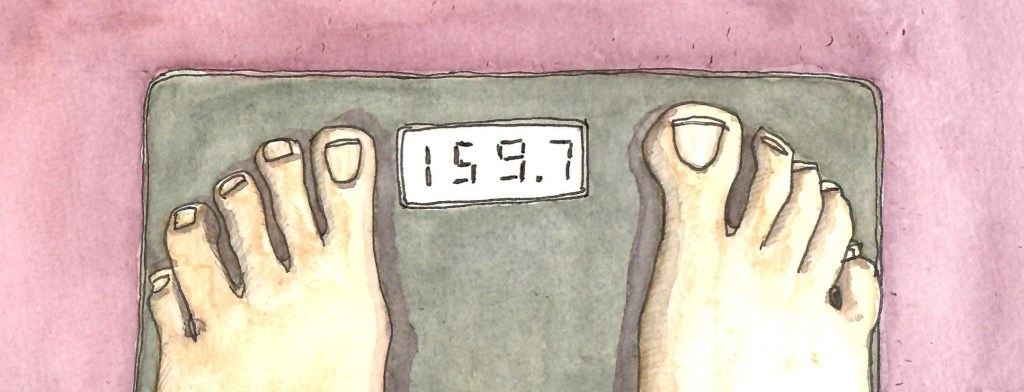
Have you had any past experience with fasting? I lost about five pounds by skipping approximately ten meals last week and simplifying all the meals I did eat. Please share your experience in the comments.
Everyone needs a hobby. Whether it’s working out at the gym, writing in a journal, tending a garden, or casting a fishing line into a stream, hobbies provide leisure and relaxation, especially for those who have recently transitioned out of the working world.
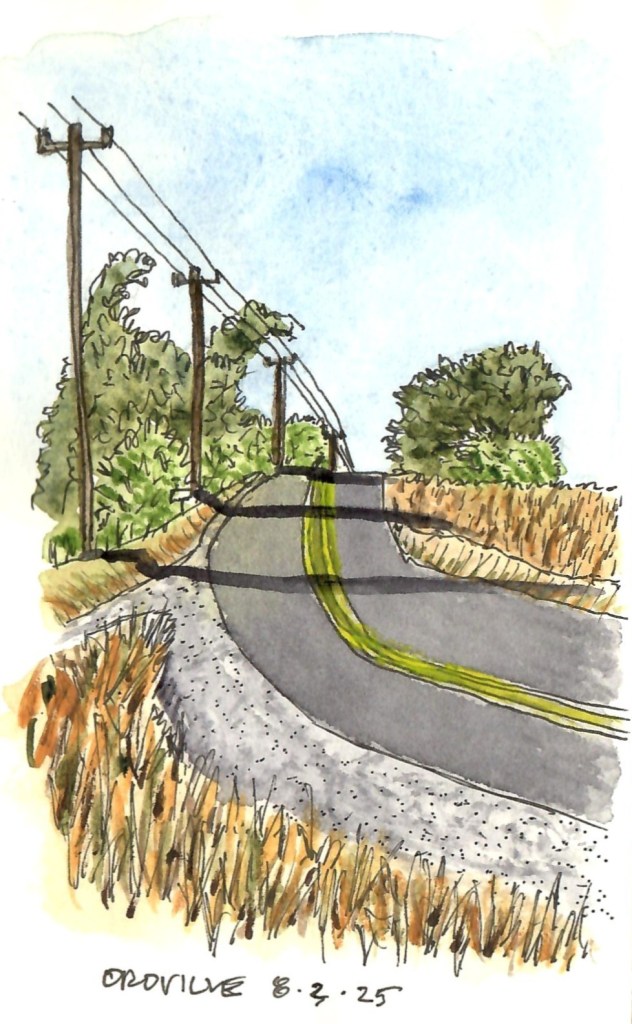
For me, I’ve found lots of relaxing pleasure when drawing and sketching with watercolor, an activity, I’ve found, that grounds me in the center of the Tao.
Flow Over Force
Watercolor teaches us to relinquish control. No matter how determined our egos may be to control the outcome of a painting, watercolor defies that control and, instead — guided by grace and fluidity — flows on its own terms, as if following its own will. Likewise, Taoism teaches us to harmonize with the natural order, to embrace surprise as an ally rather than repel it as a foe.
When painting with watercolor, each stroke is a surrender of control. We learn to adapt, to gently follow rather than impose. This dance with unpredictability is not weakness: It’s wisdom. Much like the Tao, watercolor reminds us that the soft overcomes the hard, that true freedom comes when abdicating control.
The Beauty of Impermanence
A watercolor sketch lives in the moment of creation. Its edges bleed; its colors fade. What begins with intention often ends with surprise. Taoist philosophy holds that everything is transient — like ripples in a stream or clouds passing overhead. With watercolor, impermanence is not a flaw but a virtue.
Each layer of paint dries differently, making each image unique, sui generis. An artist develops patience and humility, accepting that no intended mark will appear as intended. When completed, what remains is the spirit of the moment — a quiet reverence for the now, captured in pigment on paper.
Wu Wei in Practice
Of course, at the heart of Taoism is the concept of wu wei — the art of doing without doing. It’s not laziness, but alignment nature’s effortless flow. When applying watercolor, forcing the ego’s intention leads to muddiness; allowing things to unfold as they naturally unfurl reveals clarity and charm. A painter becomes a partner with the painted, not its maker.
Each wash of color is a meditation in non-interference. You mix, blend and brush — all without fuss. The result is often more honest than any planned outcome: It’s a surprise, a collaboration between intention and surrender. Rather than reward control, watercolor nurtures trust.
Harmony in Chaos
Watercolor thrives in the unpredictable. A splash lands off-center, a bloom spreads like mist — yet somehow, beauty emerges. Taoism sees chaos not as disorder, but as the fertile ground from which harmony blooms. When brushing on color, “accidents” become focal points, giving character and soul to a final image.
A happy watercolorist learns to welcome surprise, adjusting and adapting like a river that winds through rocky terrain. The painting process teaches that a sudden mess isn’t something to fear — it’s something to embrace, something to foster, an opportunity to discover the previously unforeseen.
Stillness in each Stroke
To paint with watercolor is to pause the world. Each stroke invites stillness — an awareness of brush, breath, and unfolding color. Taoist thought reveres quietude, seeing it as the root of insight and peace. In watercolor, distraction dulls the result, but presence sharpens the soul.
The rhythm of dipping, dabbing, and watching water glide becomes a slow dance with time. For many, early retirement is a time to dip and dabble and discover new things — some as big as a watercolor hobby, some as small as an unintended freckle on a watercolor portrait. Either way, the Tao takes the lead.
How About You?
What habits or hobbies do you plan to develop or already enjoy in retirement? Let me know in the comments.
While out on one of my afternoon walks here in San Francisco, I found a sidewalk library full of free books for the taking — no library card required.
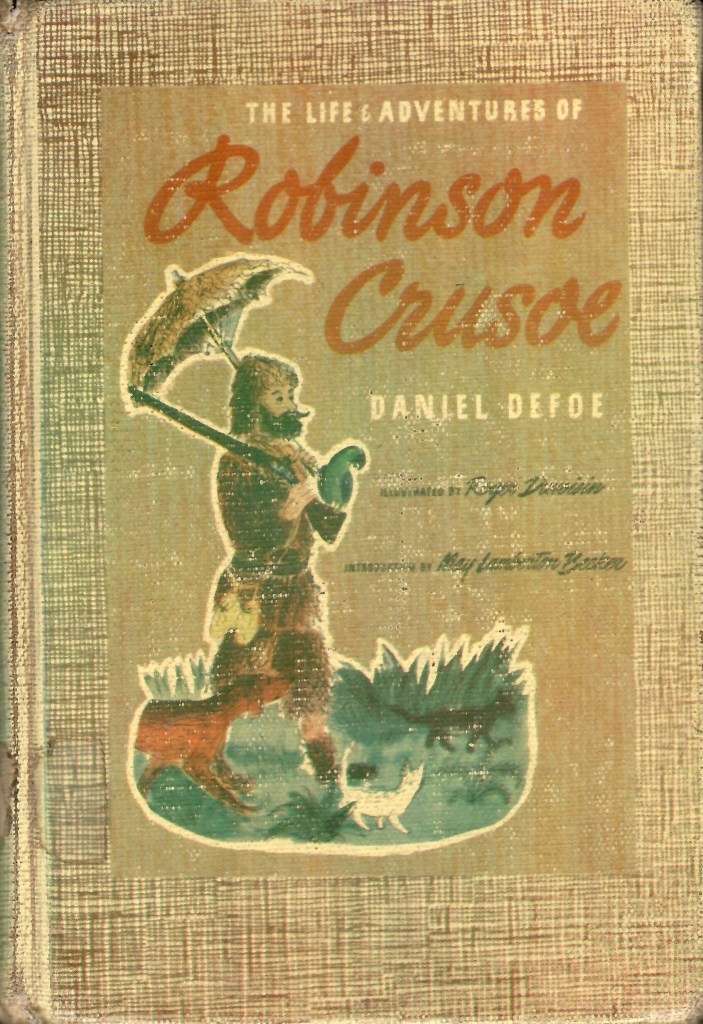
Among the many volumes jammed across the two small shelves was an old, ragged, cracked-spine, yellow-paged, 1946 edition of Daniel Defoe’s Robinson Crusoe.
Despite my senior age and three degrees in English, I had never read Defoe’s classic tale of shipwrecked adventure. So, opening the sidewalk library’s plexiglass door, I plucked the antique volume off its shelf, tucked it under my arm, and headed home to read.
Surprise! Surprise!
Three paragraphs into chapter one, I was pleased to discover several references to ancient Taoist ideas.
Of course, it’s highly unlikely that Daniel Defoe was aware of Lao-Tzu and his Taoist Book of the Way. Afterall, earliest translations into English of the Tao te Ching did not first appear until the late 19th century — more than 150 years after Robinson Crusoe was originally published in 1719.
Still, Taoist ideas lay the foundation of Defoe’s RobinsonCrusoe.
What is the Tao?
In ancient Chinese philosophy, the Tao, or the Way, represents the organic energy of life, the effortless flow of the universe. It’s the power of a river as a mountain’s melting snowfall rages toward the summer sea; conversely, it’s also the icy crust of a frozen pond in winter. Neither good nor bad, neither up nor down, neither in nor out, the Tao is comprised of all these and — mostly — everything in between.
One of the main concepts of Taoism is the idea of wu wei. Wei means any contrived action, any attempt made to thwart the natural flow of nature. Wu means no, so wu wei suggests the idea of no contrived action, of no action that goes against the flow of the Tao. Wu wei is often described as nothing, meaning no thing — that is, no thing other than the natural Tao.
Taoist Reflections
Early in chapter one, Robinson Crusoe’s father’s attempts to dissuade his son from running off to become a sailor. The father encourages his son to accept his natural status in life as a modestly well-to-do citizen, enjoying the pleasures provided by the “upper station of low life.” Such a life, the father assures his son, is the envy of both paupers and kings.
This “middle state” of society suggests the middle Way encouraged by the Tao, where extremes are best avoided, where “the high is lowered” and “the low is raised.” As stated in the Tao te Ching, what’s “most complete seems lacking,” and yet “those who are content suffer no disgrace.” Indeed, those who know when to stop chasing the wild dreams of youth go “unharmed” and “last long.”
The Tao of Retirement
Robinson Crusoe, only 18 when his story unfolds, ignores his father’s wise advice. Rather than accept the natural course of his upper-middle-class existence, he follows his dream of a life on the ocean. Soon enough, having defied both his father and the Tao, young Crusoe will eventually endure his inevitable, isolated fate.
With this early moment in the book, Defoe reminds me that there is no shame in living a simple retirement, of sitting on a porch at dusk, watching the daylight fade away into the cool embrace of night. I wish I could be satisfied with such a simple retirement. Perhaps such a fate will await me as I snuggle up to eighty. For now, though, in my mid-60s, I dream all sorts of sea-faring dreams.
Hopefully, such dreaming will not lead me to repeat Robinson Crusoe’s sad and seemingly lonely fate.
How About You?
What are your thoughts and plans for retirement? Let me know in the comments.
 Papa Gringo