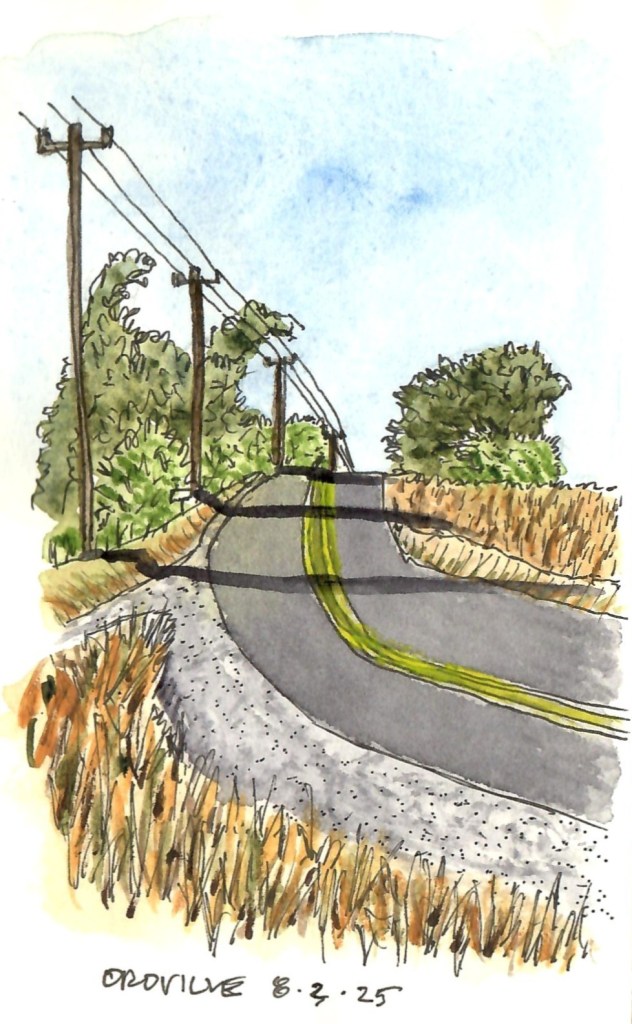
Everyone needs a hobby. Whether it’s working out at the gym, writing in a journal, tending a garden, or casting a fishing line into a stream, hobbies provide leisure and relaxation, especially for those who have recently transitioned out of the working world.
For me, I’ve found lots of relaxing pleasure when drawing and sketching with watercolor, an activity, I’ve found, that grounds me in the center of the Tao.
Flow Over Force
Watercolor teaches us to relinquish control. No matter how determined our egos may be to control the outcome of a painting, watercolor defies that control and, instead — guided by grace and fluidity — flows on its own terms, as if following its own will. Likewise, Taoism teaches us to harmonize with the natural order, to embrace surprise as an ally rather than repel it as a foe.
When painting with watercolor, each stroke is a surrender of control. We learn to adapt, to gently follow rather than impose. This dance with unpredictability is not weakness: It’s wisdom. Much like the Tao, watercolor reminds us that the soft overcomes the hard, that true freedom comes when abdicating control.
The Beauty of Impermanence
A watercolor sketch lives in the moment of creation. Its edges bleed; its colors fade. What begins with intention often ends with surprise. Taoist philosophy holds that everything is transient — like ripples in a stream or clouds passing overhead. With watercolor, impermanence is not a flaw but a virtue.
Each layer of paint dries differently, making each image unique, sui generis. An artist develops patience and humility, accepting that no intended mark will appear as intended. When completed, what remains is the spirit of the moment — a quiet reverence for the now, captured in pigment on paper.
Wu Wei in Practice
Of course, at the heart of Taoism is the concept of wu wei — the art of doing without doing. It’s not laziness, but alignment nature’s effortless flow. When applying watercolor, forcing the ego’s intention leads to muddiness; allowing things to unfold as they naturally unfurl reveals clarity and charm. A painter becomes a partner with the painted, not its maker.
Each wash of color is a meditation in non-interference. You mix, blend and brush — all without fuss. The result is often more honest than any planned outcome: It’s a surprise, a collaboration between intention and surrender. Rather than reward control, watercolor nurtures trust.
Harmony in Chaos
Watercolor thrives in the unpredictable. A splash lands off-center, a bloom spreads like mist — yet somehow, beauty emerges. Taoism sees chaos not as disorder, but as the fertile ground from which harmony blooms. When brushing on color, “accidents” become focal points, giving character and soul to a final image.
A happy watercolorist learns to welcome surprise, adjusting and adapting like a river that winds through rocky terrain. The painting process teaches that a sudden mess isn’t something to fear — it’s something to embrace, something to foster, an opportunity to discover the previously unforeseen.
Stillness in each Stroke
To paint with watercolor is to pause the world. Each stroke invites stillness — an awareness of brush, breath, and unfolding color. Taoist thought reveres quietude, seeing it as the root of insight and peace. In watercolor, distraction dulls the result, but presence sharpens the soul.
The rhythm of dipping, dabbing, and watching water glide becomes a slow dance with time. For many, early retirement is a time to dip and dabble and discover new things — some as big as a watercolor hobby, some as small as an unintended freckle on a watercolor portrait. Either way, the Tao takes the lead.
How About You?
What habits or hobbies do you plan to develop or already enjoy in retirement? Let me know in the comments.
 Papa Gringo